

Can Scoliosis Bracing Be Corrective?
Historically any reference to the use of braces for the treatment of idiopathic scoliosis was purely with the aim to prevent further progression of the curve, with the recognised ‘success’ of brace treatment being measured by the curve not worsening by up to 5 degrees in many scientific papers. This is mainly based around the realistic outcomes seen using Boston Braces, or Boston Brace style TLSOs, which are still commonly used world-wide, and is certainly the most used model within the NHS clinics in the UK.
However, with the significant advances in the understanding of scoliosis and the technology used to design braces, the braces now being used in specialist centres are changing what braces can achieve. Cheneau derivative braces (such as the CMP Brace) use corrective movements to reverse the typical scoliotic patterns, to have a significantly more effective reduction of curve size in brace, resulting in marked changes to the patient’s physical posture. This is then shown to have more positive out-of-brace influence.
With greater in brace correction, and the mechanism by which this correction is achieved, we are seeing the reversal of the scoliotic influence on the structural elements in the vertebrae, reversing the vertebral wedging, as well as targeting the soft tissue and postural changes that occur as the scoliosis develops, providing lasting, long-term changes.
More and more we are seeing actual measurable correction from bracing, measured on x-ray with the brace being removed for a set period of time. Although still many clinicians do not want to use the term ‘correction’ as a possible outcome in the treatment of scoliosis, but in reality with high quality superior over-corrective bracing this is what we are regularly seeing.
There are factors which can influence ‘correction’ and this can be related to initial curve size, stiffness/flexibility of curve, in-brace correction achieved (brace effectiveness) and compliance. When using such braces, like the CMP Brace, we are now regularly seeing ‘corrective’ bracing. This raises the question, should all clinics not be advancing their practise rather than staying with basic ‘holding’ braces that are hopefully just avoiding progression?
Below is a case example of a patient treated with the CMP brace over a 27-month period, from risser 0 (pre-adolescent growth) to full skeletal maturity at end of brace treatment.
This was an excellent success story of a girl referred with a 43° right single thoracic scoliosis just entering her adolescent growth phase. This is a curve size that is bordering on typical surgical limits, and in many centres would not have been referred for bracing and instead listed for surgery. In a typical TLSO type brace this would be a difficult curve to control, due to the size and progression risk related to the significant growth remaining.
Instead, she has got through to the end of growth with a 25° right thoracic curve, has been removed from brace treatment and now has a small and low risk curve going into adult life. She was delighted at the clear improvement in her cosmesis due to the postural re-balancing giving a much more symmetrical waist shaping.

Pre-treatment – 43°
43° single thoracic curve with significant postural collapse to right

1st in brace CMP
X-ray – 14°
Significant correction of major thoracic curve with much improved postural control
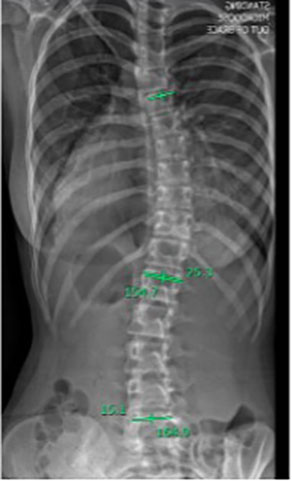
10 months in CMP treatment. Out of brace x-ray – 25°
Out of brace x-ray showing correction of both Cobb and posture

2nd in brace CMP
X-ray – 14°
Cobb correction maintained but slight overcorrection achieved in posture

End of treatment
(27 months) – 25°
X-ray taken 48 hours out of brace for true picture of curve stability and correction achieved
Pre-treatment – 43°
43° single thoracic curve with significant postural collapse to right
1st in brace CMP
X-ray – 14°
Significant correction of major thoracic curve with much improved postural control
10 months in CMP treatment. Out of brace x-ray – 25°
Out of brace x-ray showing correction of both Cobb and posture
2nd in brace CMP
X-ray – 14°
Cobb correction maintained but slight overcorrection achieved in posture
End of treatment
(27 months) – 25°
X-ray taken 48 hours out of brace for true picture of curve stability and correction achieved